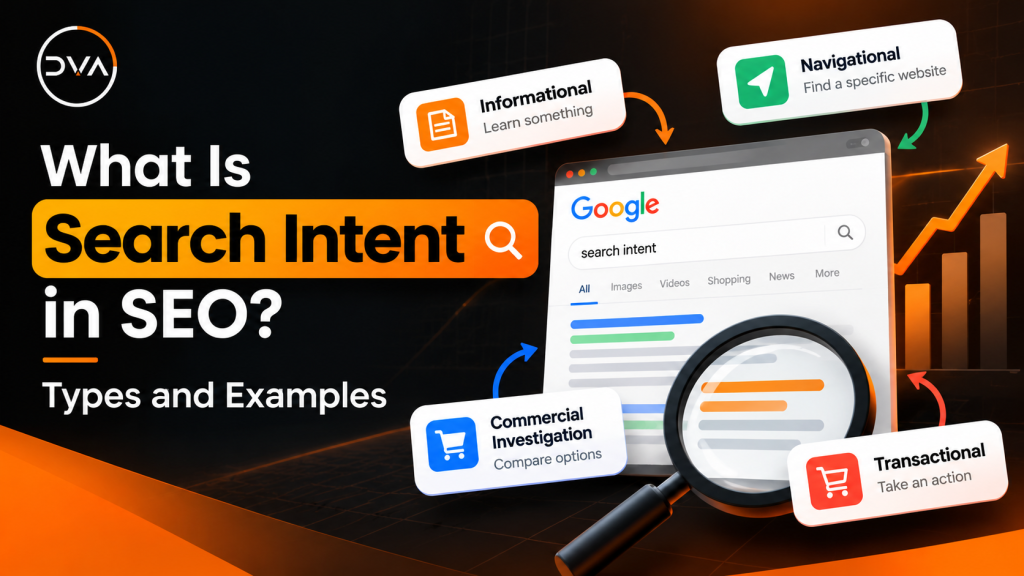
Search intent in SEO is the reason behind a user’s search query. It helps you understand whether someone wants to learn something, find a particular website, compare available options, or complete an action such as making a purchase.
For example, a person searching for what is SEO wants an explanation, while someone searching for best SEO tools is likely comparing solutions. A user searching for SEO course fees may be evaluating training options before enrolling.
Search intent is important because content should satisfy what people are actually looking for. When you understand the purpose behind a keyword, you can choose the right content format, answer relevant questions and build a more effective SEO strategy.
In this guide, you will learn what search intent means, its four main types, practical examples, how to identify intent using Google search results, and how to optimize content for search intent.
What Is Search Intent in SEO?
Search intent, also known as user intent or keyword intent, is the goal a person wants to achieve when entering a query into a search engine.
In SEO, understanding search intent means analyzing what users expect to find and creating a page that meets that expectation.
For example, consider these three searches:
- What is keyword research? — the user wants to learn a concept.
- Best keyword research tools — the user wants to compare tools.
- Buy keyword research software — the user wants to purchase a product.
Although all three queries relate to keyword research, each has a different purpose. Publishing the same type of article for all three searches may not satisfy the user’s needs.
Search intent helps you align the keyword, page type, content structure and call to action with the user’s goal.
Why Is Search Intent Important in SEO?
Search intent helps you create content that answers the right question in the right format. It also helps you decide which keywords belong on blog posts, landing pages, product pages or comparison articles.
Here are the main benefits of search intent optimization.
1. Helps you create relevant content
Understanding intent helps you decide what information a page needs to include. An informational query usually requires a clear explanation, while a comparison query may need feature comparisons, advantages, limitations and practical recommendations.
2. Helps you choose the correct page type
Not every keyword should be targeted with a blog post. Some queries are better served by a service page, course landing page, product page or tutorial.
For example, what is technical SEO is suitable for an informational guide, while SEO course may require a dedicated course landing page.
3. Improves the user experience
When visitors find the information they expected, they can understand the topic more easily and move to the next relevant step.
Useful headings, examples, concise definitions and logical navigation make content easier to use.
4. Supports keyword mapping and internal linking
Search intent helps you group related keywords by purpose and assign them to the right pages.
You can then link a supporting article to a broader SEO guide, related tutorials and a relevant course page without making every page target the same keyword.
5. Helps prevent content overlap
Two articles targeting almost identical queries with the same intent may compete for similar search visibility.
Intent-based keyword mapping helps you identify when to create a new article and when to improve an existing one.
What Are the Four Main Types of Search Intent?
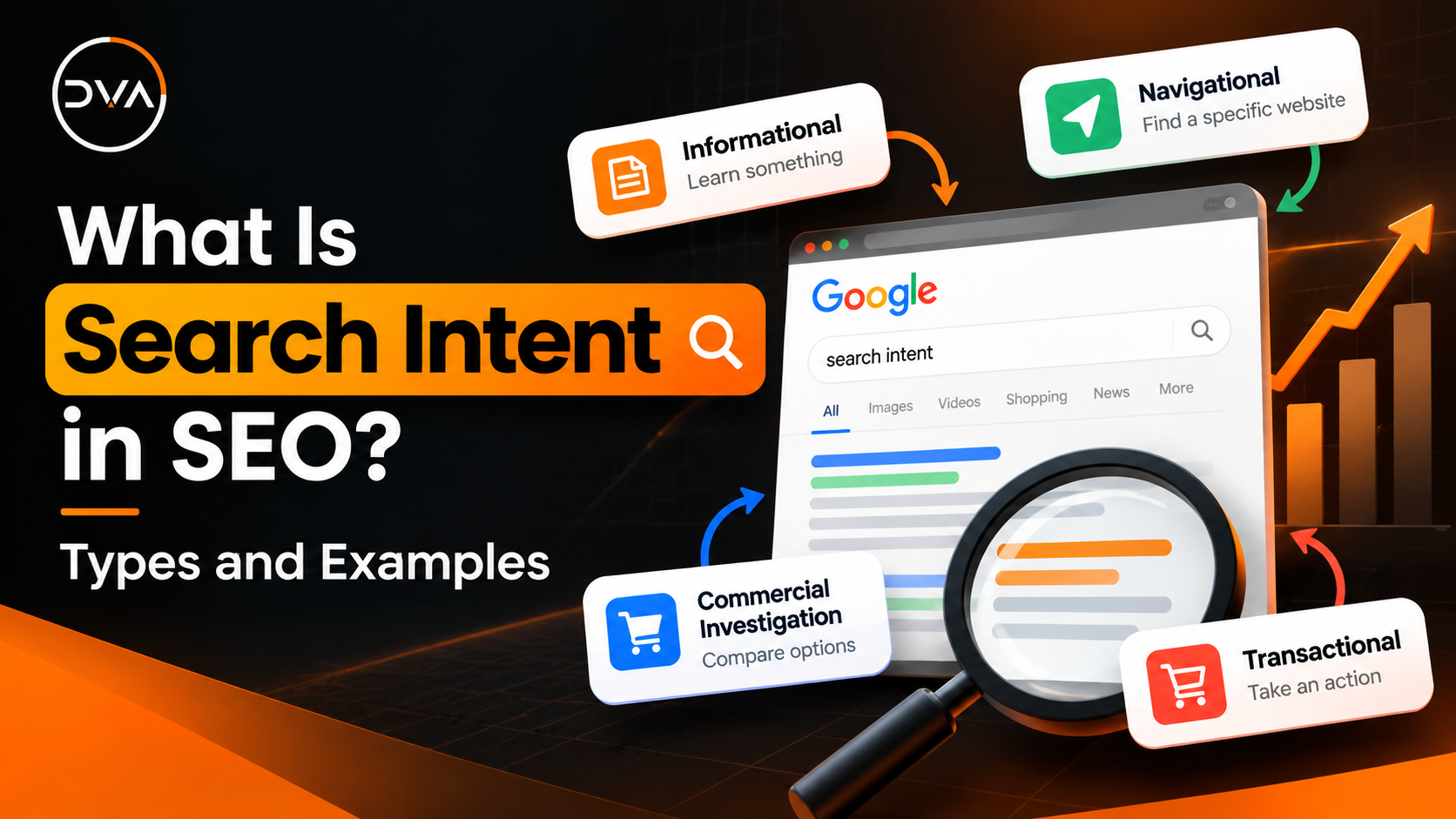
The four commonly used search intent categories are informational, navigational, commercial investigation and transactional.
| Search intent | User’s goal | Example query | Suitable page type |
| Informational | Learn or understand something | What is search intent? | Guide or tutorial |
| Navigational | Find a specific website or page | Google Search Console login | Official website or login page |
| Commercial investigation | Compare options before deciding | Best SEO tools for beginners | Comparison or review article |
| Transactional | Complete an action or purchase | Buy SEO software | Product or conversion landing page |
These categories are useful working models, not rigid rules. A search can have mixed intent, and the most appropriate content format depends on the actual query and search results.
1. Informational Search Intent
Informational search intent occurs when a user wants to learn something, understand a concept, solve a problem or follow instructions.
The user is primarily looking for information rather than trying to make an immediate purchase.
Examples of informational search intent
| Search query | What the user wants |
| What is search intent in SEO? | A clear definition and explanation |
| How does keyword research work? | A step-by-step process |
| What is technical SEO? | An understanding of technical SEO |
| How to track form submissions with GTM | Practical implementation instructions |
| What is Google Analytics 4? | An explanation of GA4 |
What content should you create for informational keywords?
Depending on the query, suitable formats include:
- Beginner’s guides
- How-to articles
- Step-by-step tutorials
- Definitions and explainers
- Checklists
- Educational videos
- Troubleshooting guides
For example, the query what is search intent in SEO is best addressed with a comprehensive guide that defines search intent, explains the main types and shows practical examples.
If the reader wants to learn the topic more deeply, you can link to related resources such as your SEO guide, keyword research article and technical SEO checklist.
SEO tip: Answer the main question near the beginning of the article. Then expand with examples, explanations, practical steps and related questions.
2. Navigational Search Intent
Navigational search intent occurs when a user wants to reach a particular website, brand, tool or webpage.
The user usually already knows where they want to go.
Examples of navigational search intent
| Search query | User’s goal |
| Google Search Console login | Open Search Console |
| Google Analytics | Visit Google Analytics |
| Digital With Ankur website | Find the Digital With Ankur website |
| Rank Math login | Find the Rank Math login page |
| Meta Ads Manager | Open Meta’s advertising platform |
What content should you create for navigational keywords?
Navigational searches are usually best served by the official destination, a clearly identifiable brand page or the specific page the user is trying to reach.
For a business website, this can mean maintaining:
- A clear homepage and brand identity
- A useful About page
- Accessible contact information
- Descriptive page titles
- Consistent internal navigation
- Correct canonical URLs and indexability settings
A navigational query is not automatically an opportunity to create a new blog post. If the user wants to log in to a third-party platform, the most useful result is generally the official login page.
SEO tip: Do not force a general informational blog to target a branded navigational query when the user is clearly trying to reach a specific destination.
3. Commercial Investigation Search Intent
Commercial investigation occurs when a user researches, compares or evaluates options before making a decision.
The user may not be ready to purchase immediately, but they want information that helps them choose.
Examples of commercial investigation search intent
| Search query | User’s goal |
| Best SEO tools for beginners | Compare SEO tools |
| Ahrefs vs Semrush | Evaluate two products |
| Best digital marketing course in India | Compare training options |
| Google Ads vs Meta Ads | Understand the differences |
| Best WordPress SEO plugins | Compare plugins |
What content should you create for commercial investigation keywords?
Suitable formats include:
- Comparison articles
- Product reviews
- Feature comparison tables
- Pros and cons guides
- Tool roundups
- Alternatives articles
- Course comparison guides
For example, an article titled Google Ads vs Meta Ads: Key Differences, Costs and Use Cases should explain how the platforms differ, when each is useful, what factors affect costs and how businesses can choose between them.
Avoid declaring one option the best for everyone. Explain the criteria and circumstances that influence the decision.
SEO tip: Support comparisons with current, verifiable information. If you discuss course fees, platform features or product pricing, make sure the details are accurate and clearly dated when necessary.
4. Transactional Search Intent
Transactional search intent occurs when a user wants to complete an action. That action could be buying a product, booking a service, registering for a course or downloading a resource.
The user may already have decided what they want.
Examples of transactional search intent
| Search query | Likely goal |
| Buy Ahrefs subscription | Purchase a subscription |
| Enroll in SEO course | Register for training |
| Book digital marketing consultation | Schedule a service |
| Download SEO audit template | Obtain a resource |
| Register for Google Ads certification | Begin registration or training |
Not every transactional query involves payment. Downloading a template or registering for a free event can also represent an action-oriented goal.
What content should you create for transactional keywords?
Suitable page types include:
- Product pages
- Course landing pages
- Service pages
- Booking pages
- Registration pages
- Download pages
A transactional landing page should make the next step clear. Depending on the offer, it may need transparent pricing, course details, benefits, eligibility, genuine testimonials, an enquiry form and a clear call to action.
For example, someone searching for an SEO course may need a dedicated page explaining the curriculum, delivery format, practical projects, fees and available support.
You can direct interested readers to the Digital With Ankur SEO Course page when they want to explore structured SEO training.
SEO tip: Do not turn every informational article into a sales page. Give readers the information they came for and offer a relevant next step when appropriate.
What Is the Difference Between Search Intent and Keyword Intent?
Search intent and keyword intent are commonly used to describe the same underlying concept: the purpose behind a search query.
The term search intent often emphasizes the user’s goal, while keyword intent is frequently used when discussing keyword research, classification and content planning.
For example, what is technical SEO and technical SEO course concern the same topic but suggest different goals.
The first is primarily informational. The second may indicate commercial or transactional intent, depending on the search results and the user’s stage in the decision process.
In practice, SEO professionals should analyze the complete query, its context and the content currently ranking rather than relying only on the words used.
How to Identify Search Intent for a Keyword
You can identify likely search intent by examining the query, reviewing search results and understanding the type of answer the user expects.
Follow these steps before creating a new article.
Step 1: Identify the purpose of the query
Ask what the user is trying to accomplish.
For example:
- What is SEO? suggests learning.
- Best SEO tools suggests comparison.
- SEO course fees suggests evaluation.
- Enroll in SEO course suggests an action.
These are useful initial clues, but the wording alone does not always reveal the complete intent.
Step 2: Analyze the Google search results
Search for the target keyword in Google and examine the results that appear.
Look for:
- The types of pages ranking on the first page
- Common headings and topics
- Official pages, tutorials, listicles or landing pages
- Featured snippets and other visible search features
- Questions users may need answered
- The level of detail provided by competing pages
If the results mainly contain educational guides, that is evidence that an informational article may be appropriate. If they mainly contain product or service pages, consider whether a commercial or transactional page better matches the query.
Search results can change by location, language, device and time, so treat this analysis as evidence rather than a permanent rule.
Step 3: Examine related questions and queries
Look for related searches and follow-up questions that reveal what people want to understand.
For an article about search intent, useful questions might include:
- What are the four types of search intent?
- How does search intent affect SEO?
- How do you identify keyword intent?
- What is the difference between informational and transactional intent?
Use these questions when they genuinely improve the article. Do not add irrelevant headings simply to include more keywords.
Step 4: Choose the correct page format
Map the intent to a suitable content format.
| Intent | Recommended format |
| Informational | Educational guide or tutorial |
| Navigational | Brand page or official destination |
| Commercial investigation | Comparison or review |
| Transactional | Product, service or course landing page |
The purpose is to satisfy the query, not to force every keyword into a blog article.
Step 5: Review and improve the content
After publishing, monitor the page in Google Search Console.
Review which queries generate impressions, whether the page attracts relevant clicks, and whether the content answers the questions users are searching for.
If the queries indicate a different intent from the one you originally targeted, consider updating the article, changing its scope or creating a separate page only when the intent is genuinely distinct.
How to Optimize Content for Search Intent
Once you understand the query’s purpose, use the following process to create a more relevant page.
1. Match the title to the search query
Your title should clearly communicate what the reader will learn or accomplish.
For an informational keyword, a title such as What Is Search Intent in SEO? Types and Examples tells the reader exactly what to expect.
2. Answer the primary question early
Include a concise definition in the introduction. Readers should not have to scroll through unrelated information to discover the basic answer.
3. Use headings that reflect real questions
Organize the article into logical sections. For this topic, the four intent types, practical examples and the process of identifying intent are useful headings because they directly address the subject.
4. Include practical examples
Examples help readers understand how a concept applies to real searches.
Use a mix of beginner, technical and commercial examples where relevant. Explain why each query fits its category instead of simply listing keywords.
5. Add relevant internal links
Link to related content that provides further information.
For example, readers learning about search intent may also benefit from guides on SEO fundamentals, keyword research and technical SEO.
Use descriptive anchor text and make sure the destination provides the information promised by the link.
6. Make the content easy to scan
Use short paragraphs, descriptive headings, lists and comparison tables when they help readers understand the information.
A clear structure supports usability, but formatting alone does not guarantee rankings or inclusion in AI-generated search summaries.
7. Demonstrate experience and accuracy
Use original examples, screenshots or documented workflows where appropriate. Check factual claims and cite authoritative sources when explaining platform features or technical recommendations.
8. Add a relevant next step
If readers want to learn SEO in more depth, you can link to an appropriate tutorial or training page. Keep the call to action relevant to the topic and avoid interrupting the informational experience.
How Does Search Intent Help With Keyword Mapping?
Search intent helps you decide which keywords belong on the same page and which need separate pages.
Consider the following examples:
| Keyword | Intent | Recommended page |
| What is SEO? | Informational | Main SEO guide |
| What is keyword research? | Informational | Keyword research article |
| What is search intent? | Informational | Search intent article |
| Technical SEO checklist | Informational / practical | Technical SEO checklist |
| SEO course | Commercial / transactional | SEO Course landing page |
These pages are related, but each serves a distinct purpose.
Your main SEO guide should connect to relevant supporting articles. The search intent article should link back to the main guide and to one or two related guides, such as keyword research and technical SEO. It can also link to the SEO Course page when readers want structured training.
This creates a useful content network without requiring every article to target the same keyword.
Common Search Intent Mistakes to Avoid
Targeting a keyword without checking the results
A keyword may look informational but have mixed intent. Review the search results before choosing the page format.
Creating multiple pages for the same intent
Publishing several articles that answer the same question in nearly identical ways can create unnecessary overlap. Improve an existing page when it already satisfies the query.
Adding keywords without answering the question
Keyword placement cannot compensate for content that fails to satisfy the reader’s needs.
Making unsupported claims
Avoid promising that search intent optimization will guarantee rankings, traffic or AI Overview visibility. Results depend on many factors.
Overloading informational articles with sales messages
A relevant course link is useful. Turning every paragraph into a promotion can make the article less helpful.
Frequently Asked Questions About Search Intent
What is search intent in SEO?
Search intent in SEO is the purpose behind a user’s search query. It helps content creators understand whether someone wants information, a specific website, a comparison or a way to complete an action.
What are the four types of search intent?
The four commonly used types are informational, navigational, commercial investigation and transactional. They describe different goals users may have when searching online.
Why is search intent important for SEO?
Search intent helps you create relevant content, choose the right page format, map keywords to appropriate URLs and provide a better experience for visitors.
How do you find search intent for a keyword?
Start by examining the query, then review the current search results, identify the types of pages ranking and determine what information or action those pages provide. Use this evidence to choose your content format.
Can a keyword have more than one search intent?
Yes. Some queries have mixed intent, and different users may want different things. Search results can also contain several page types. Examine the dominant intent and address closely related needs where appropriate.
What is the difference between informational and transactional search intent?
Informational intent means the user wants to learn or understand something. Transactional intent means the user wants to complete an action, such as purchasing a product, registering for a course or downloading a resource.
Does search intent affect keyword research?
Yes. Keyword research is more useful when you group queries by purpose instead of treating every keyword about the same topic as interchangeable. Intent helps determine which queries can be served by one page and which need separate pages.
How does search intent help with AI Overviews?
Clear, accurate and well-organized content can help search systems understand what a page answers. However, satisfying search intent does not guarantee inclusion in Google AI Overviews or any other AI-generated search feature.
Conclusion
Search intent is a fundamental part of an effective SEO strategy because it connects keyword research with the information users actually need.
The four common intent types—informational, navigational, commercial investigation and transactional—help you decide whether to create a guide, a brand page, a comparison article or a conversion-focused landing page.
Before publishing a page, identify the query’s purpose, analyze the current search results, choose the right content format and answer the main question clearly.
To build your SEO knowledge further, explore our guide to SEO and keyword research tutorial. If you want structured learning and practical guidance, visit the Digital With Ankur SEO Course page.