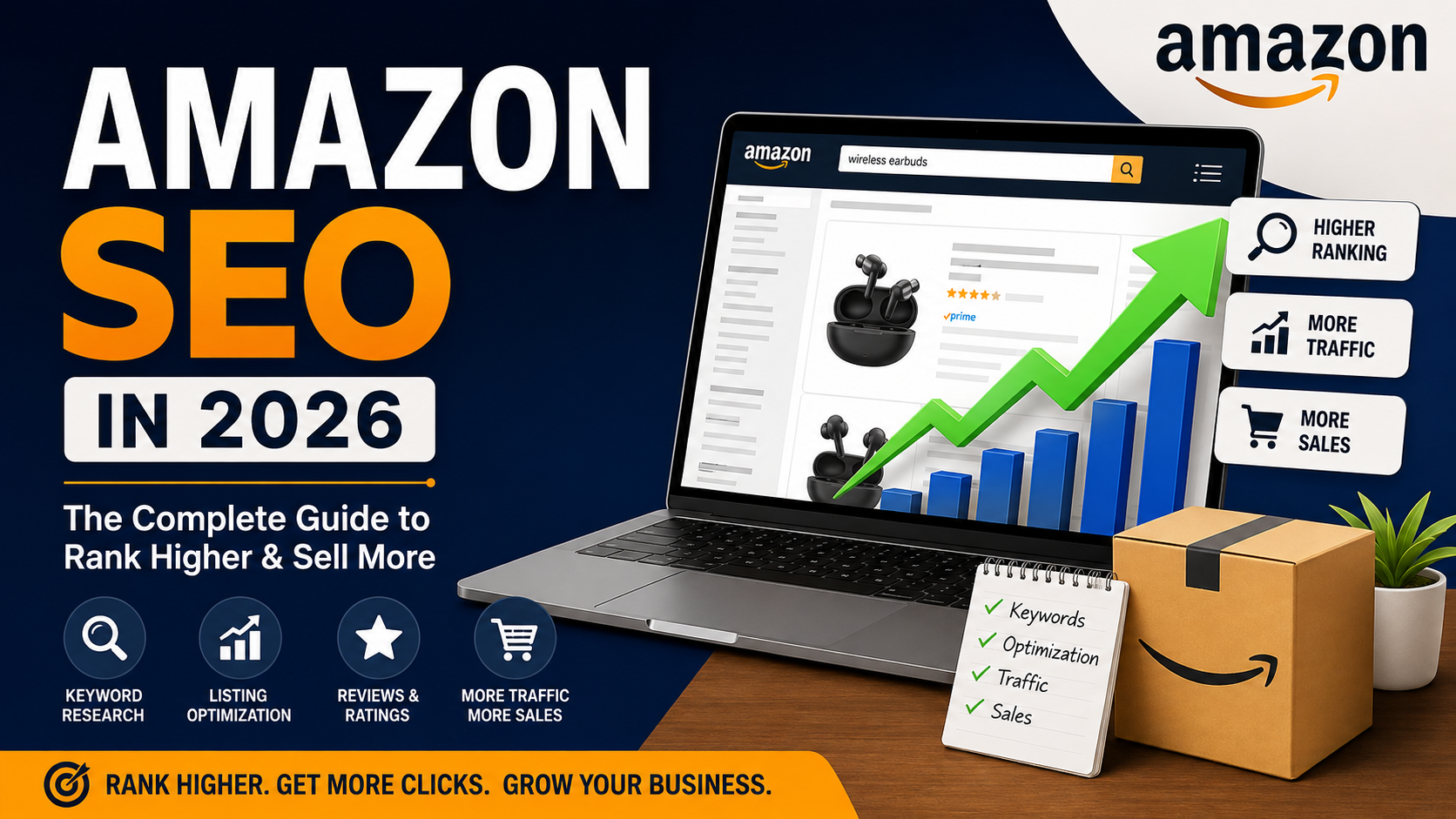

If you are selling products on Amazon, getting your product listed is only the first step. The bigger challenge is getting your products in front of the right customers when they search on Amazon. This is where Amazon SEO becomes important.
Amazon SEO is the process of optimizing your product listing so that Amazon can better understand your product, match it with relevant customer searches, and give shoppers the information they need to make a purchase.
In 2026, Amazon SEO is not simply about adding keywords to a product title. A strong strategy combines keyword research, listing optimization, product relevance, conversion rate, reviews, pricing, images, inventory, sales performance, PPC, customer experience, and continuous testing.
Amazon itself recommends optimizing product titles, descriptions, keywords, images, and other listing elements to improve discoverability and conversions.
If you are completely new to Amazon selling, don’t worry. This guide explains Amazon SEO step by step in simple language.
What Is Amazon SEO in 2026?
Amazon SEO is the process of optimizing an Amazon product listing to improve its visibility in Amazon search results and increase the chances of getting clicks, conversions, and sales.
Think about your own Amazon search behavior.
Suppose you want to buy a stainless steel water bottle. You might search:
stainless steel water bottle
Amazon then has to decide which products should appear for that search.
Your product needs to be:
- Relevant to the customer’s search
- Properly optimized
- Attractive enough to receive clicks
- Convincing enough to generate sales
- Available for purchase
- Competitively priced
- Supported by a good customer experience
This is why Amazon SEO is broader than keyword placement.
Amazon SEO vs Google SEO
There is an important difference between Google SEO and Amazon SEO.
Google primarily helps users find information, websites, services, and products across the web.
Amazon primarily helps users find products they may want to buy.
Therefore, purchase intent is extremely important in Amazon SEO.
For example:
Broad keyword:
shoes
More specific keyword:
men’s running shoes
High-intent keyword:
men’s running shoes for gym workout
The more closely your listing matches the customer’s search intent, the more useful the traffic can become.
How Does Amazon SEO Work?
Amazon SEO works by helping Amazon understand two important things:
- What your product is
- How useful your product is for shoppers
Imagine Amazon receiving thousands of products for the search:
wireless keyboard
Amazon needs to decide which products are relevant and which ones should appear higher.
Your product listing provides Amazon with information through areas such as:
- Product title
- Item Highlights
- Bullet points
- Product description
- Backend search terms
- Product category
- Product attributes
- Images
- Brand information
- Reviews
- Pricing
- Sales performance
- Conversion behavior
Amazon also looks at how shoppers interact with products.
For example:
Search → Click → Product page → Add to cart → Purchase
If your listing receives impressions but very few clicks, you may have a visibility problem or a weak search-result presentation.
If you receive clicks but very few purchases, your problem may be related to:
- Price
- Images
- Product benefits
- Reviews
- Product quality
- Description
- Trust
- Offer
- Customer expectations
This is why Amazon SEO and conversion optimization should work together.
Why Is Amazon SEO Important for Sellers?
Amazon is a highly competitive marketplace.
You may have an excellent product, but customers cannot buy it if they cannot find it.
Amazon SEO can help you:
Increase Product Visibility
Better listing relevance can help your products appear for relevant customer searches.
Attract More Organic Traffic
When your product becomes visible for relevant searches, you can potentially receive traffic without paying for every individual click.
Improve Click-Through Rate
An optimized title, strong main image, competitive price, and clear value proposition can encourage shoppers to click.
Improve Conversions
Once customers reach your product page, good content and strong visuals can help them understand the product and make a purchase decision.
Reduce Dependence on Paid Traffic
PPC can be useful, but sellers should ideally build organic visibility alongside paid campaigns.
Build Long-Term Product Growth
A well-optimized listing can become a stronger asset as sales, customer feedback, and brand awareness grow.
What Factors Affect Amazon Product Rankings?
There is no single factor that guarantees a top Amazon ranking.
A practical Amazon SEO strategy should consider several areas.
1. Keyword Relevance
Your listing should contain relevant terms customers actually use when searching.
2. Product Relevance
Your product must genuinely satisfy the search intent behind the keyword.
3. Click-Through Rate
If shoppers frequently see your product but do not click, it may struggle to compete for visibility.
4. Conversion Rate
Getting visitors is not enough. You also need to convert relevant shoppers into customers.
5. Sales Performance
Consistent sales can contribute to overall product performance.
6. Reviews and Ratings
Strong reviews can improve customer confidence and conversions.
7. Pricing
An unrealistic price can reduce clicks and conversions compared with competing products.
8. Product Images
Images communicate product quality before customers read your listing.
9. Inventory Availability
If your product frequently goes out of stock, your growth can suffer.
10. Customer Experience
Returns, complaints, product quality, and seller performance can affect the overall health of your Amazon business.
The important lesson is simple:
Amazon SEO is not just a keyword game.
How to Do Keyword Research for Amazon SEO
Keyword research is one of the first steps in Amazon SEO.
Your goal is to discover the words and phrases customers use when searching for products similar to yours.
Step 1: Start With Your Product
Write down exactly what you sell.
For example:
Stainless Steel Water Bottle
Now expand it:
- stainless steel bottle
- steel water bottle
- insulated water bottle
- reusable water bottle
- gym water bottle
- office water bottle
- leak proof water bottle
- water bottle for travel
Step 2: Study Amazon Search Suggestions
Start typing your product keyword into Amazon’s search box.
Amazon may provide suggestions based on common searches.
These suggestions can give you ideas for keyword research.
Step 3: Analyze Competitors
Find products competing for your target keyword.
Study:
- Their titles
- Bullet points
- Product descriptions
- Product features
- Product attributes
- Images
- Reviews
- Customer questions
Do not copy competitors.
Instead, identify the topics and phrases customers repeatedly care about.
Step 4: Find Long-Tail Keywords
Long-tail keywords are more specific search phrases.
For example:
Broad:
water bottle
Long-tail:
stainless steel water bottle for gym
Long-tail searches may have lower search volume but can often provide clearer purchase intent.
Step 5: Group Your Keywords
Create groups such as:
Primary keyword
stainless steel water bottle
Secondary keywords
- insulated water bottle
- reusable steel bottle
- leak proof bottle
- gym water bottle
Long-tail keywords
- stainless steel water bottle for gym
- insulated steel bottle for office
- leak proof water bottle for travel
This makes listing optimization easier.
How to Choose the Right Keywords for Your Amazon Product
Do not select keywords simply because they have high search volume.
A keyword should be relevant to your product.
Consider five things:
Relevance
Does the keyword accurately describe your product?
Search Demand
Are customers actually searching for it?
Competition
How many strong competitors are targeting the keyword?
Buying Intent
Does the search indicate that the customer may be ready to purchase?
Product Match
Can your product genuinely satisfy the search?
A smaller, highly relevant keyword can sometimes be more valuable than a huge keyword that brings the wrong audience.
Where to Use Keywords in an Amazon Product Listing
Important keyword locations can include:
- Product title
- Item Highlights
- Bullet points
- Product description
- Backend search terms
- Product attributes
- Relevant listing fields
However, you should never force the same keyword repeatedly.
Amazon’s own listing guidance recommends using relevant search terms throughout listing content.
The goal is:
Relevant keyword → useful information → better customer experience
Not:
Keyword → keyword → keyword → keyword
How to Optimize Amazon Product Titles for SEO
The product title is one of the most important parts of your listing.
But Amazon’s title rules have changed significantly in 2026.
Starting July 27, 2026, titles in most categories except media are required to be 75 characters or fewer, including spaces. Amazon also introduced Item Highlights, which provide an additional 125 characters for materials or recommended use cases. Amazon says both Item Name and Item Highlights are inputs for search.
This means sellers should stop thinking:
“How many keywords can I put in my title?”
Instead think:
“How clearly can I communicate the product and its most important value?”
A Simple Amazon Title Structure
A practical structure can be:
Brand + Product Type + Key Feature + Important Attribute + Size/Quantity
Example:
ABC Stainless Steel Water Bottle 1L Insulated
The exact format should always follow your category’s requirements.
Amazon Title Best Practices
- Keep the title clear
- Use the primary keyword naturally
- Mention important product attributes
- Avoid unnecessary repetition
- Avoid keyword stuffing
- Follow Amazon category rules
- Make the title easy to understand on mobile
- Focus on shoppers rather than search engines alone
How to Optimize Amazon Bullet Points for SEO
Bullet points help customers quickly understand why they should consider your product.
Instead of simply describing features, explain the benefit.
Weak Bullet
Stainless steel body.
Better Bullet
DURABLE STEEL BUILD – Made with stainless steel for everyday use at home, work, gym, or travel.
The second version gives the shopper more useful information.
A Simple Bullet Structure
You can organize bullets around:
- Main product benefit
- Key feature
- Problem solved
- Use case
- Important specification
Use relevant secondary keywords naturally.
Amazon’s own listing guidance identifies bullet points as an important area for highlighting key product details and attributes.
How to Write SEO-Friendly Amazon Product Descriptions
Your product description should answer the customer’s basic questions.
Explain:
- What is the product?
- Who is it for?
- What problem does it solve?
- What makes it different?
- How should it be used?
- What are its important specifications?
Simple Writing Formula
Problem → Product → Benefits → Features → Use Case
For example:
Looking for a reusable bottle for everyday travel? This stainless steel water bottle is designed for office, gym, and outdoor use. Its durable construction and leak-resistant design make it suitable for daily carrying.
Notice that the keyword is included naturally.
You do not need to repeat “water bottle” in every sentence.
What Are Amazon Backend Search Terms?
Backend search terms are search terms that sellers provide in Amazon’s listing fields to help Amazon understand additional relevant searches for the product.
These terms are not primarily written for customers to read.
They can be useful for:
- Alternative phrases
- Synonyms
- Search variations
- Relevant terms that do not fit naturally into visible copy
Example
If your product is a:
Women’s Leather Wallet
Potential relevant variations might include:
- ladies wallet
- women purse wallet
- compact leather wallet
- card holder wallet
Only use terms that genuinely relate to the product.
Avoid:
- Irrelevant keywords
- Competitor brand names
- Repeated keywords
- Misleading terms
- Keyword stuffing
The goal is relevance, not maximum keyword count.
How to Optimize Amazon Product Images for Better Conversions
Images are one of the strongest conversion elements on an Amazon product page.
A customer cannot physically touch your product through a screen.
Your images therefore need to communicate:
- Product appearance
- Size
- Features
- Use case
- Benefits
- Materials
- Dimensions
- Product details
Your Main Image
The main image should clearly show the actual product and follow Amazon’s image requirements.
Avoid making the image confusing or overloaded.
Secondary Images
Use additional images to explain:
- Product dimensions
- Important features
- Product usage
- Materials
- Benefits
- Comparison
- Lifestyle scenarios
Image Strategy
Think of your image gallery as a salesperson.
Each image should answer another customer question.
For example:
Image 1: What is the product?
Image 2: What are its main features?
Image 3: How big is it?
Image 4: How is it used?
Image 5: Why is it better?
Good images can improve understanding and conversion, which indirectly supports your overall Amazon SEO performance.
How A+ Content Can Improve Amazon Product Performance
A+ Content allows eligible sellers and brands to add richer visual and informational content to product detail pages.
Depending on eligibility, A+ Content can include:
- Enhanced images
- Videos
- Customized text
- Comparison charts
- Interactive modules
- Brand Story content
Amazon says Basic A+ Content can increase sales by up to 8% and well-implemented Premium A+ Content by up to 20%, based on Amazon’s internal data.
These are Amazon-reported potential improvements, not guaranteed results.
How A+ Content Helps
A+ Content can help customers:
- Understand the product
- Compare features
- Learn about your brand
- See the product in use
- Feel more confident about buying
It is therefore better to think of A+ Content primarily as a conversion and brand-building tool, rather than a magic ranking trick.
How Reviews and Ratings Affect Amazon Product Ranking
Reviews are extremely important for Amazon sellers.
A customer seeing:
4.6 stars with hundreds of reviews
will usually feel more confident than seeing:
2.9 stars with a small number of reviews.
Reviews can influence:
- Customer trust
- Click behavior
- Conversion rate
- Product perception
- Purchase decisions
This can affect overall product performance.
How to Build Better Reviews Ethically
Focus on:
- Product quality
- Accurate product information
- Good packaging
- Fast and reliable fulfillment
- Customer satisfaction
- Accurate expectations
Never build your Amazon SEO strategy around fake or manipulated reviews.
How Pricing Affects Amazon Product Visibility and Sales
Price directly influences purchase decisions.
Suppose three similar products are priced at:
- ₹499
- ₹699
- ₹1,299
Customers may compare:
- Price
- Rating
- Reviews
- Features
- Brand
- Images
- Delivery
- Warranty
A higher price does not automatically mean poor performance.
Your product needs to communicate enough value to justify the price.
Monitor Your Competitors
Regularly compare:
- Selling price
- Discounts
- Coupons
- Ratings
- Reviews
- Product features
- Offers
- Delivery options
Your goal is not always to become the cheapest seller.
Your goal is to provide a compelling value proposition.
Does Amazon PPC Help Organic Product Ranking?
Amazon PPC and Amazon SEO are different but complementary strategies.
PPC provides paid visibility.
SEO focuses on organic discoverability and listing relevance.
PPC can help you:
- Generate traffic
- Test keywords
- Discover customer search behavior
- Generate sales
- Promote new products
- Increase product visibility
However, you should not assume:
“If I spend more on PPC, Amazon will automatically rank my product organically.”
Organic ranking depends on multiple relevance and performance signals.
A better strategy is:
SEO + PPC + Conversion Optimization
Use PPC to bring relevant traffic while continuously improving your listing.
Amazon also provides experimentation tools that allow sellers to test product content such as titles, images, descriptions, bullet points, and A+ Content.
How to Rank a New Product on Amazon
Launching a new product can be difficult because the product does not have a long sales history.
Start with strong foundations.
Step 1: Research the Market
Understand:
- Competitors
- Prices
- Reviews
- Product features
- Customer complaints
- Search terms
Step 2: Optimize the Listing
Prepare:
- Strong title
- Relevant keywords
- Clear bullets
- Helpful description
- Backend search terms
- High-quality images
Step 3: Set Competitive Pricing
Do not price blindly.
Study your market and understand your product’s value.
Step 4: Launch PPC Carefully
Start with relevant campaigns.
Monitor:
- Impressions
- Clicks
- CTR
- CPC
- Orders
- Conversion
- ACoS
- ROAS
Step 5: Improve Conversion
If you receive traffic but few sales, improve:
- Images
- Offer
- Price
- Content
- Reviews
- Product positioning
Step 6: Monitor Results
Do not make ten changes at once.
Test, measure, and improve.
How to Improve the Ranking of an Existing Amazon Product
If your product already receives traffic but is not ranking well, first identify the problem.
Situation 1: Low Impressions
Possible issues:
- Weak keyword targeting
- Poor relevance
- Incorrect category
- Limited demand
- Weak listing optimization
Situation 2: High Impressions but Low Clicks
Improve:
- Main image
- Title
- Price
- Rating
- Search-result presentation
Situation 3: High Clicks but Low Sales
Improve:
- Product page
- Images
- Description
- Bullets
- A+ Content
- Reviews
- Price
- Offer
Situation 4: Good Sales but Ranking Is Not Growing
Check:
- Keyword relevance
- Competitive landscape
- Sales consistency
- Conversion rate
- Inventory
- Pricing
- Organic vs paid traffic
This diagnostic approach is much better than randomly changing keywords.
Amazon SEO Mistakes Sellers Should Avoid in 2026
1. Keyword Stuffing
Do not repeat the same keyword everywhere.
2. Writing for Amazon Instead of Customers
Your listing should be easy for humans to understand.
3. Ignoring Amazon Policies
A ranking strategy is useless if your listing violates marketplace requirements.
4. Using Irrelevant Keywords
Traffic from the wrong audience does not help much.
5. Using Poor Images
Bad images can destroy conversion.
6. Ignoring Mobile Users
Customers frequently browse Amazon on mobile devices.
7. Copying Competitors
Study competitors, but create your own positioning.
8. Ignoring Reviews
Customer feedback can reveal product and listing problems.
9. Never Testing Your Listing
Amazon provides experimentation tools for eligible sellers and content types. Use data instead of guessing.
10. Depending Only on PPC
Paid traffic can help, but it should complement your organic strategy.
11. Ignoring Inventory
A product cannot generate sales when it is unavailable.
12. Using Outdated Title Strategies
Amazon’s 2026 title changes make old title-writing advice unreliable. For most categories, titles are now limited to 75 characters, while Item Highlights provide additional searchable space.
Best Amazon SEO Tools for Sellers in 2026
You do not necessarily need every SEO tool available.
Choose tools based on the problem you are trying to solve.
Amazon Seller Central
This should be your primary platform for managing listings, inventory, advertising, reports, and seller performance.
Amazon Brand Analytics
For eligible brands, Amazon Brand Analytics provides useful customer and search-related data.
Amazon highlights Search Terms and Search Query Performance data as useful for understanding how customers discover and interact with products.
Amazon Search Suggestions
The Amazon search bar itself can provide useful keyword ideas.
Amazon Advertising Console
Useful for:
- PPC campaigns
- Keyword testing
- Search-term analysis
- Advertising performance
Helium 10
Useful for keyword research, competitor research, listing optimization, and product research.
Jungle Scout
Useful for product research, keyword research, and marketplace analysis.
DataDive
Useful for deeper keyword and ranking analysis.
Keep the Tool Stack Simple
A beginner does not need ten different tools.
Start with:
Amazon Seller Central + Amazon Brand Analytics + one good keyword research tool
Then expand when necessary.
How to Track Amazon SEO Performance
You cannot improve what you do not measure.
Create a simple tracking sheet for every important product.
Track:
- Target keyword
- Current ranking
- Impressions
- Clicks
- CTR
- Sessions
- Unit session percentage
- Orders
- Conversion rate
- Sales
- Advertising sales
- Organic sales
- ACoS
- ROAS
- Reviews
- Rating
- Price
- Inventory
Track Changes Over Time
Do not judge your Amazon SEO strategy from one day’s data.
Compare:
Week 1 → Week 2 → Week 3 → Week 4
Look for trends rather than isolated numbers.
Amazon SEO Metrics Every Seller Should Monitor
Here are some of the most useful metrics.
Organic Keyword Ranking
Shows where your product appears for important search terms.
Impressions
Shows how frequently your product is displayed.
Click-Through Rate
CTR tells you how many people click after seeing your product.
Sessions
Shows visits to your product detail page.
Conversion Rate
Shows how effectively traffic becomes orders.
Sales
One of the most important business metrics.
Advertising Cost of Sales
ACoS helps you understand advertising spend relative to advertising sales.
ROAS
ROAS measures revenue generated from advertising relative to advertising spend.
Reviews
Monitor both the number and quality of reviews.
Rating
A product with a poor average rating can struggle to convert shoppers.
Inventory
Monitor stock carefully so successful products do not become unavailable.
Advanced Amazon SEO Strategies for 2026
Once you understand the basics, move toward a more advanced strategy.
1. Build Keyword Clusters
Instead of targeting one keyword, create groups.
For example:
Core keyword:
yoga mat
Feature cluster:
- non slip yoga mat
- thick yoga mat
- extra grip yoga mat
Use-case cluster:
- yoga mat for home
- yoga mat for beginners
- yoga mat for exercise
This creates a broader relevance strategy.
2. Map Keywords to Listing Elements
Do not place everything in the title.
Create a keyword map.
| Listing Element | Keyword Purpose |
|---|---|
| Title | Primary product terms |
| Item Highlights | Key attributes/use cases |
| Bullets | Features + benefits |
| Description | Supporting terms |
| Backend | Additional relevant variations |
| Attributes | Structured product information |
3. Analyze Competitor Weaknesses
Read negative reviews on competing products.
Look for repeated complaints.
For example:
“Bottle leaks.”
If your product genuinely solves that problem, make it a clear part of your messaging.
4. Optimize for Conversion
Ranking brings traffic.
Conversion turns traffic into business.
You need both.
5. Run Controlled Tests
Change one important element at a time where possible.
For example:
Test A: Current main image
Test B: New main image
Measure the result.
Amazon’s Manage Your Experiments feature supports testing different listing content and evaluating which version performs better.
How AI Is Changing Amazon SEO in 2026
AI is becoming increasingly important in Amazon selling.
Amazon itself offers AI-powered tools that can help sellers create product listing content.
AI can help sellers with:
- Keyword grouping
- Listing drafts
- Product descriptions
- Competitor analysis
- Customer review analysis
- Content ideas
- Image concepts
- Search-term classification
- Data analysis
But there is an important rule:
Do not blindly publish AI-generated content.
AI can produce:
- Incorrect product claims
- Repeated phrases
- Generic descriptions
- Wrong specifications
- Unnatural language
Use AI as an assistant.
The seller remains responsible for checking:
- Product facts
- Claims
- Measurements
- Compatibility
- Keywords
- Amazon policy compliance
AI + Human Review
A good workflow is:
Research → AI assistance → Human editing → Amazon policy check → Publish → Measure → Improve
This is more reliable than simply asking AI to “write an Amazon listing.”
Amazon SEO Strategy for Indian Sellers
Indian sellers need to consider both Amazon SEO and local buying behavior.
If you are selling on Amazon.in, research keywords specifically for the Indian marketplace.
Do not assume that keywords popular in the US will perform the same way in India.
Understand Indian Search Behavior
Customers may search using:
- English
- Hinglish
- Product-specific terms
- Local expressions
- Size-based searches
- Use-case searches
For example, customers may search for:
school bag for boys
or:
kids school bag
Your research should identify the phrases actually used by your target customers.
Analyze Indian Competitors
Check:
- Amazon.in search results
- Competitor prices
- Ratings
- Reviews
- Product features
- Delivery
- Images
- Offers
Focus on Value
Indian buyers often compare products carefully.
Make your value proposition clear.
Explain:
- What the customer gets
- Why it is useful
- What makes it different
- What problem it solves
Do Not Ignore Pricing
Calculate your complete economics.
Consider:
- Product cost
- Amazon fees
- Shipping
- Packaging
- Advertising
- Returns
- Taxes
- Discounts
A product that ranks well but loses money is not a successful Amazon SEO strategy.
Amazon SEO Checklist for Sellers in 2026
Use this checklist before publishing or updating a product.
Keyword Research
- Primary keyword identified
- Secondary keywords identified
- Long-tail keywords researched
- Customer search intent understood
- Competitor keywords analyzed
Listing
- Product title optimized
- Title follows current Amazon requirements
- Item Highlights optimized where applicable
- Bullet points clearly explain benefits
- Product description is easy to understand
- Backend search terms are relevant
- Product attributes are accurate
Images
- Main image is clear
- Product is easy to understand
- Secondary images explain features
- Dimensions are shown where useful
- Lifestyle images are relevant
- Images follow Amazon requirements
Conversion
- Price is competitive
- Product offer is attractive
- Reviews are monitored
- Rating is monitored
- Product page answers customer questions
- A+ Content is used where eligible
PPC
- Relevant keywords targeted
- Search terms monitored
- Wasteful spend reduced
- Conversion tracked
- ACoS monitored
- ROAS monitored
Performance
- Organic rankings tracked
- Impressions tracked
- CTR tracked
- Conversion rate tracked
- Sales tracked
- Inventory monitored
- Listing changes documented
Frequently Asked Questions About Amazon SEO
What is Amazon SEO?
Amazon SEO is the process of optimizing your product listing to improve its visibility for relevant Amazon searches and increase the chances of clicks and sales.
How can I rank my products higher on Amazon?
Use relevant keywords, optimize your listing, improve images and conversion rate, maintain competitive pricing, build a good customer experience, monitor performance, and use PPC strategically.
Which keywords should I use for Amazon SEO?
Use keywords that accurately describe your product and match what your customers search for. Include primary, secondary, long-tail, synonym, and product-specific terms naturally.
Does Amazon PPC help with SEO ranking?
Amazon PPC and organic Amazon SEO are different. PPC can generate traffic and sales, but it should complement your organic strategy rather than replace listing optimization.
How long does Amazon SEO take to work?
There is no fixed timeframe. Results depend on competition, product relevance, sales, conversion rate, reviews, demand, pricing, and other performance factors.
Do Amazon reviews affect product ranking?
Reviews can improve customer trust and conversion, which can influence overall product performance. Sellers should focus on product quality and customer experience rather than manipulating reviews.
What are Amazon backend search terms?
Backend search terms are relevant keywords entered through Amazon listing fields to help Amazon understand additional search queries related to a product.
What is the best Amazon SEO strategy in 2026?
The best Amazon SEO strategy combines keyword research, listing optimization, strong images, conversion optimization, competitive pricing, customer experience, PPC, data analysis, testing, and continuous improvement.
Want to Learn Amazon Selling From Scratch?
Learning Amazon SEO is only one part of becoming a successful Amazon seller.
You also need to understand:
- Product research
- Product sourcing
- Amazon Seller Central
- Product listing creation
- Keyword research
- Amazon SEO
- Amazon PPC
- Pricing
- Inventory
- Order management
- Customer service
- Product launches
- Sales analysis
- Marketplace growth
If you are completely new to Amazon selling, learning these areas step by step can help you avoid expensive beginner mistakes.
A structured Amazon Seller Course can help you understand the complete process instead of learning every topic separately from random videos and articles.
The goal should not simply be:
“Learn how to sell on Amazon.”
The goal should be:
“Learn how to research, launch, optimize, market, and grow products on Amazon.”
Final Takeaway
Amazon SEO in 2026 is much bigger than adding keywords to a product title.
A successful strategy connects:
Keyword Research → Listing Optimization → Images → Conversion → Reviews → Pricing → PPC → Sales → Testing → Continuous Improvement
If you are a beginner, start with the basics.
First understand your customer.
Then research the keywords they use.
Create a relevant and useful listing.
Improve your images.
Set a competitive offer.
Bring relevant traffic through PPC.
Measure the results.
Then keep improving based on data.
Remember one simple principle:
Amazon SEO helps customers discover your product, but a great product listing gives them a reason to buy it.
You can Also checkout this:
AMAZON SELLER CENTRAL SEUP GUIDE
5 Recommended External Links
Amazon Product Discoverability & Listing Optimization
Optimise Your Product Discoverability – Amazon Seller Central
Amazon Brand Analytics
Amazon Brand Analytics – Sell on Amazon
Amazon Manage Your Experiments
Manage Your Experiments – Sell on Amazon
Amazon 2026 Product Title Update
Amazon Product Title Updates for 2026
Amazon Search Query Performance
Amazon Search Query Performance – Brand Analytics